The wave that never was
The engine had no shooting at all. A week later it had 94 guns, endless zombie waves and a boss named the Overlord. Plus new land, rivers and fishing where skill decides.
Fishing where skill decides
The week began with a requirement: fishing shouldn't be “wait and press”, it should be a place where skill decides. By Monday morning the fish had character. Junk doesn't resist, cod is calm, salmon is lively, and treasure is wild. After a bite two bars appear above the hotbar: tension and progress. The fish alternately rests and lunges, and yanking while it lunges is three times as risky as while it rests. The greedy snap the line, the timid run out of time — whoever watches the fish wins.
Meanwhile you could barely see the float: it was a tiny fishing-rod icon, and it didn't always draw at that. The complaint “I can't tell whether I'm fishing or not” turned into a real float — white bottom, red top, an antenna and a line from your hand. And on every island we dug a pond and left a fishing rod as a gift: the islands had no water at all, and a rod could only be made from string, which drops… from fishing.
Six updates in two days
On Tuesday something unpleasant came to light: nobody could say for sure which version of the game was on the live server. From that day on, every update is checked against its contents. In two days the server was updated six times — and each time players waited less than half a second.
The same day one of us sat down to play on a phone and got kicked out after three minutes. The cause wasn't the phone: the server itself was dropping about a third of browser sessions. It waited for a player's reply as if they were in the next room, not on the other side of the country. By evening it was fixed and shipped at once — after the fix, a quarter of an hour of the live log showed not a single such drop.
Land that came alive
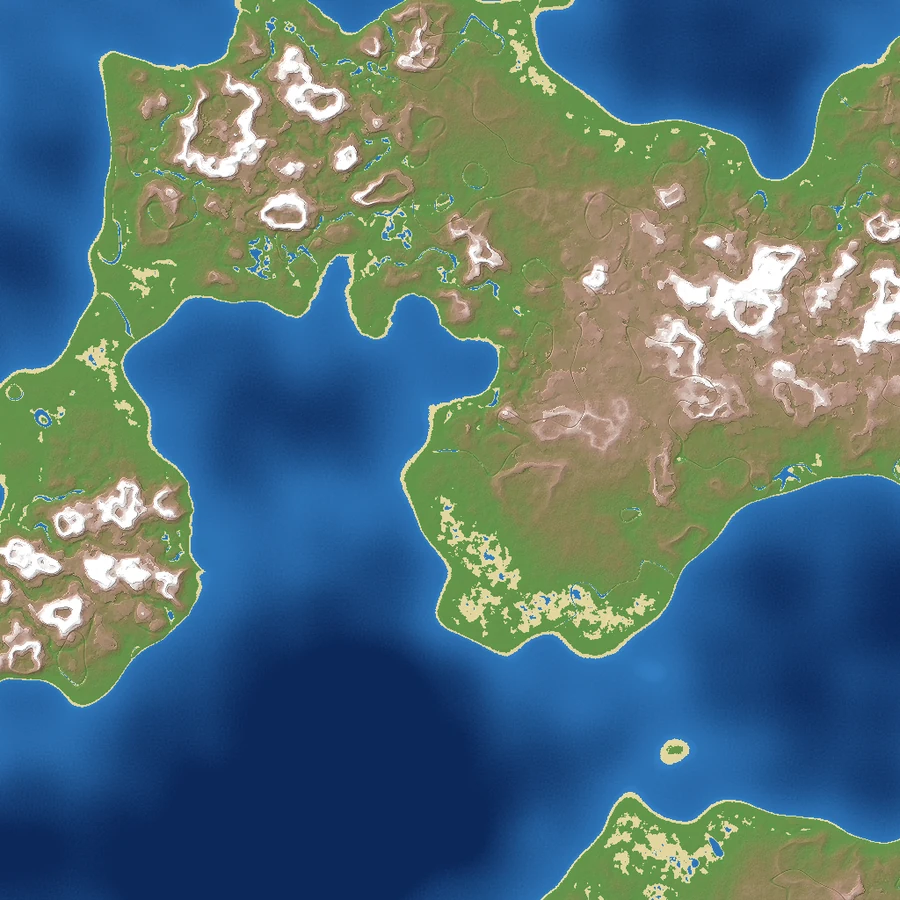
“The generation is so-so,” was said about the survival world, and in two days the land became different. Rivers flowed through valleys, caves appeared underground, the world got a climate, and there were 19 biomes instead of 8. Water covered more than half the world — at our own request it went down to about a tenth, but lakes with waterfalls appeared in the mountains. When the new world turned out to have not a single tree, forests grew by biome: spruces in the taiga, acacias in the savanna, birches and oaks in the forest, lone trees in the meadows.
Along the way two funny finds turned up. The spawn point ended up underwater for every world seed — at the very center of the map the noise is always zero. And 81% of the islands in the sea were “mushrooms”: a cap of land on a thin stalk. Now spawn looks for the nearest dry flat spot on its own, and the mushrooms became islands.
The third mode
On August 11 a third mode was ordered: zombie waves and guns. And right away came the question: do maps in our game have to be made of blocks? The answer was “no”. The arena became the first Mypex map not made of blocks — 72 by 72 meters, three levels and eighteen pieces of cover.
Shooting was harder: the engine simply didn't have it. Hits, magazines and reloading were written from scratch, and the server calculates them. The first six guns got Russian names — “Key”, “Dragonfly”, “Bulwark”, “Equal”, “Long One” and “Storm”. They lived for two days.
The first version of the mode turned out boring — that's how it was judged, only shorter and saltier. A day later the mode was redone entirely. Waves became endless, moving to the next one resets a 150-second timer, and every five waves the zombies get tougher. Guns unlock by level, and level builds up between rounds. A fallen player can return to the fight as a zombie and hunt the living. There's no armor in the mode and no prize for winning — only experience and thrill. The zombies themselves — eleven tiers of one body in different colors, brutes, bonies, the boss Overlord and the hunter Wendigo — were sculpted by one of us.
And the six Russian guns made way for ninety-four — with 3D models, sounds, muzzle flashes and smoke. The armory became a screen of cards you can flip through and sort by level. Until August 12, shooting happened in total silence: the player pulled the trigger, the magazine emptied, the zombie fell — and not a sound.
A window instead of a hub
On August 12 it was decided there should be no hub at all: instead, a nice window with mode buttons, a picture and a description opens when you join. That's how the selection window with three painted posters came about: survival — daytime, a house and a cross-section of the earth; islands — an island in the void with a waterfall; Zombie Rush — a night arena with three figures walking. Nobody ever saw the stone hall built on the chronicle's first evening again.
Fifty notes
The second half of the week consisted of notes from playing ourselves — more than fifty in a week. A dead zombie “hung” for a second and blocked the ones behind it — now it crumbles into debris. An item in hand, seen from the side, dangled somewhere near the feet. Zombies' arms were twisted backwards — and it turned out it had always been that way. The shotgun counted one pellet out of twelve, and multi-bullet guns dealt 41% of the promised damage on average. All of this was fixed.
On Sunday hunger was redone. It no longer takes hearts: a hungry player walks 30% slower, the game says so in words, and fullness drains ten times slower. Real farmland appeared — in survival the hoe used to be sold, but you couldn't till with it. Underwater the player got an air bar: before, health drained without a single sign on screen. And the window title, the loading screen and the chat finally said “Mypex” instead of the program's internal name.