A world that builds itself
From the very start the project had a rule: no generation, only ready-made maps. On August 7 it was lifted with a single sentence — “We're doing generation, yes, our own.” Less than a day later, the Mypex world began building itself for the first time.
“There's almost nobody to hit”
Monday began with us merging everything that had been built in parallel over the week — more than five hundred changes in one day. And we immediately checked which promises actually worked. We found something unpleasant: the player defeated all 17 kinds of creatures, and 14 of them couldn't hit back at all — not even the wolf and the spider. The mechanism for their anger had been written, but nobody had ever switched it on. The conclusion was short: “There's almost nobody to hit. Players will hit each other. We'll make bosses later.” That same evening a wolf that got hit started hitting back.
Along the way it turned out that calves died in two hits and dropped a grown cow's meat — a herd of calves was a better source of meat than a herd of cows. Now the calf has its own loot.
A map moved over whole
On August 5 the survival world got the real map of the old Mypex: spawn, PvP arenas, signposts — and trampolines. A plate on a block launches the player up, there are four kinds of trampolines, and the golden one sends you where you're looking. The map has more than two thousand of them. Before that, the /spawn command led 427 blocks sideways and 137 down — right under the map, into the void; now spawn is in its place and no longer faces a wall.
The same day armor worked for the first time. Until August 5 its tables simply weren't in the game: helmets and chestplates were worn for looks. Now what you wear soaks up damage — but never makes a hit harmless. A PvP mode appeared too: any hit, yours or against you, starts a 10-second fight, each next hit resets the countdown, and leaving the game in a fight means death. The countdown is shown on screen. And death got words: the server tells you who killed you and with what.
Fifty complaints
From Wednesday began a life familiar to anyone who has ever made a game: we started playing it ourselves. In five days about fifty short complaints piled up, and each was traced to its cause.
Doors wouldn't open, and on the imported map 69% of doors stood “broken”: the top half hung on a different wall. The best pickaxe mined stone as slowly as a bare hand — 9.6 seconds; now it's 0.55. The hand trembled when you did nothing. The head looked up when you looked down — and that was true for every player. With the pause menu open the character kept walking and wandered off twenty-odd blocks. You couldn't climb ladders — you fell right through them, and fences could be jumped with room to spare. At night it was pitch black. Wherever you stood, a gust of wind noise rolled in every 1.2 seconds: the wave was baked into the sound itself, and there was nothing to stop it. And a broken chair dropped to the ground as gray stone — the pictures matched almost pixel for pixel.
Creative mode was a story of its own. The “Tools” tab showed 48 decorative blocks and nothing else: the word “axe” was hiding in those blocks' English names. Five tabs out of six were empty. We sorted out the catalog and also hid four hundred-odd items that won't be in the game.
Eight minerals and the question “where do we mine them”
On August 7 eight new minerals came into the game — 128 items: ore, blocks, ingots, tools and armor. At first there were no recipes for them, and to the question “are there new crafts?” the honest answer was “no” — overnight there were 168. But there was a more serious question: where do you mine all this if there's no ore in the ground? Ready-made maps don't contain ore.
That same evening the “no generation” rule was lifted: “We're doing generation, yes, our own.” Let's note right away: of the eight minerals, only two will remain in the game later — amethyst and iridium. But that's still a month away.
Less than a day
Less than a day passed between the permission and the first generated land. On August 8 the new world “Wild Lands” got coasts with sandy beaches, seas and mountains with snowy peaks. Three hours later — eight biomes and the ore of each mineral at its own depth. One column of the world was built in fifteen hundredths of a millisecond.
The most interesting finds weren't made by checks but by pictures from above. All automatic checks were green, yet on the image the coast crumbled “into confetti”. The second picture showed that the border between stone and deepslate was drawn as if with a ruler, and under all the world's land lay a thin layer of void. Since then we look at the world with our eyes, not just numbers.
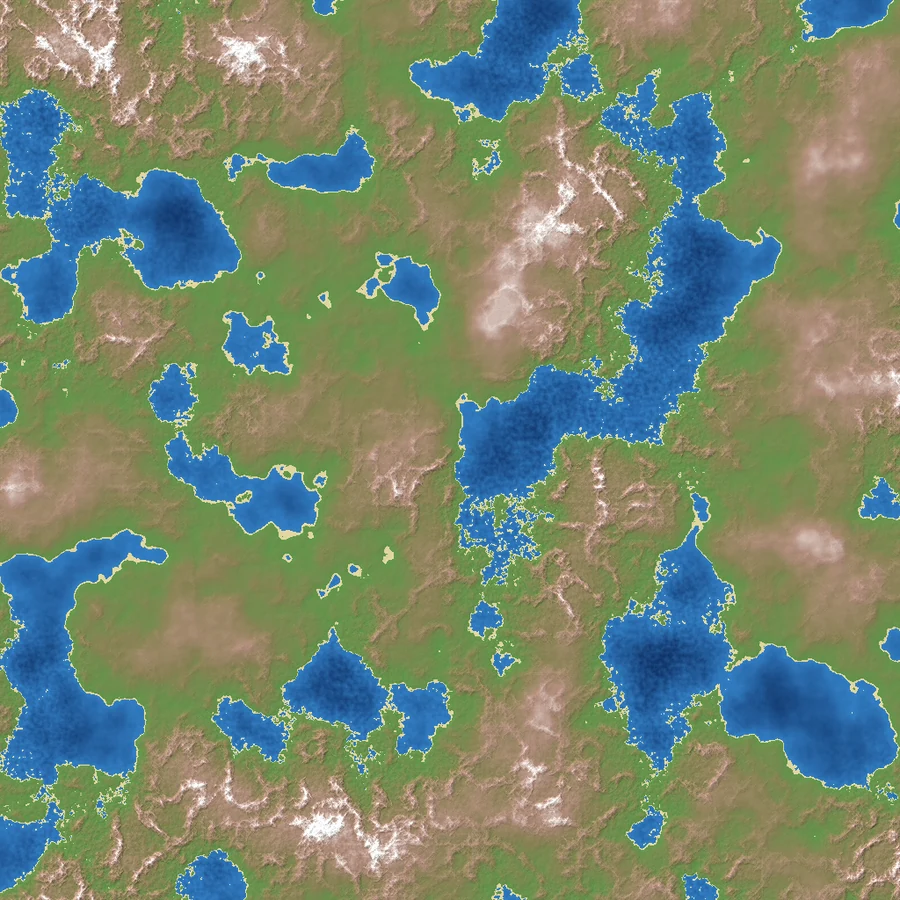
On August 9 the fate of the survival world was decided: “Keep only the spawn claim, and beyond it make new generation.” It was said three times. The seam between the old map and the new land was measured right away: on average a 23-block drop, in the worst place 85. Turning on the generator broke a dozen automatic checks that expected a flat world. The generator was switched off, the checks were rewritten, and it was switched back on the same day.
And a few more things
The separate survival hub — that very island from the first chapter — was removed: “There's a spawn in the survival world. The hub isn't needed anymore.” The shared lobby is now always at noon: before, every player had their own clock, and the lobby went dark for seven minutes out of every twenty. Hunger and food appeared — and three cakes, whose models were drawn by one of us. The chest became a two-column window — your pockets on the left, the chest on the right. The furnace got a real window instead of a menu of eight buttons. Sprinting got faster, crouching became a bow at the waist, and in creative mode flying became classic: up, down and no inertia.