A float at the bottom of the sea
The float lay 64 blocks underwater, the line grew out of the hip, and the character held the fishing rod like an apple. This was the week we played every day ourselves — and fixed everything that annoyed us the same day.
Playing it ourselves
This week has an unusual shape. The middle is almost empty — from August 19 to 21, just twenty-one changes. All that time we simply played and wrote down what was wrong. And then, over the weekend of August 22 and 23, more than half of the whole week's work happened. The notes from those days hold more than twenty short complaints — and almost every one was closed that same evening.
Zombies that learned to climb stairs
It started with the Zombie Rush arena. The complaint was simple: too many places you can climb onto where zombies can't reach you anymore. We counted: 929 of the arena's 6,672 cells turned out to be unreachable, almost one in seven. But it wasn't only the map's fault. More than half of those spots were unreachable because zombies couldn't find a path — they walked straight at the player and ran into a wall.
The choice was: draw a new map or teach zombies to think. We chose the second. Now a zombie finds the stairs itself: in testing it climbed the steps more than six blocks up to a player sitting on a tower. Zombies also stopped clumping together. Before, three of them heading for one player stood on a single spot, and the player saw one zombie with three health bars.
The Overlord — the wave's boss — had no sound at all. It struck with its eyes from afar, and the player lost health for no visible reason. Now the hit is heard by whoever it lands on. The arena gallery, where railings covered all the tiles, became walkable for the first time. And the mode card stopped promising a “prize for winning” that didn't exist.
Fishing: three complaints — three different bugs
On August 19 we decided to finish fishing and farming completely. The first thing we found was that the world had no shared clock. Time of day wasn't stored anywhere: for each player the sun moved across their own screen, and the longer they played, the further their morning drifted from their neighbor's. And both bites and plant growth depend on the time of day. From that day on, day and night became shared for the whole world and survive a server restart.
On the morning of August 21 three complaints came in about the same spot. The float lies somewhere in the depths. The line grows out of the hip. The rod is held strangely. They turned out to be three different bugs: the float was drawn exactly 64 blocks below the water, the line attached somewhere other than the rod's tip, and the game thought the rod was food and held it like an apple.
Catching got its own mini-game — the “Precise Hook”: after a bite, a pointer runs along a bar with colored zones, and the zone under it decides whether the fish gets away or not. First one of us wrote “fishing doesn't work — it won't press”, and a minute later: “it does press, turns out I just didn't get it at first.” Since then a miss explains itself in words: “Miss: no fish there” or “It got away”. At sea, fish now have to be played — reel in while it rests, don't yank while it lunges. And the rod's yank, the only action in a fight with a fish, finally made a sound: a splash if you pull at the right time, the hiss of a taut line if you yank too hard.
A garden that lives by the seasons
Wheat a second after planting looked like a ripe ear: the plant had one picture for all growth stages. Now you can see the crop grow. And by the weekend the garden beds got a life of their own: they need water, every plant has its season, without water the harvest withers, in winter without a greenhouse it dies, and a crow can steal it if there's no carved-pumpkin scarecrow nearby. There's one season for the whole mode — walking into the next world doesn't turn spring into winter.
One word: “want an interface”
On August 22 three screenshots arrived of our own screens redrawn in a new style, and one word: “want interface”. By evening the game's windows were carved: wooden frames, blue-green steel along the edges, flourishes in the corners and a gem over the middle. The layout didn't shift by a single cell — only the paint changed.
The furnace got three labeled slots instead of five identical ones: on top what you smelt, at the bottom the fuel, on the right the result. That matters more than it seems: thirty items out of a hundred and fifty both smelt and burn, and before, the game decided on its own what to do with a log. Now the player decides — by which slot they put it in. And the complaint “you can't cook a tropical fish” turned out to be true — the furnace only knew two fish out of four. That's how cooked tropical fish came about: the first item of our own made for the sake of food.
The beach that wasn't there
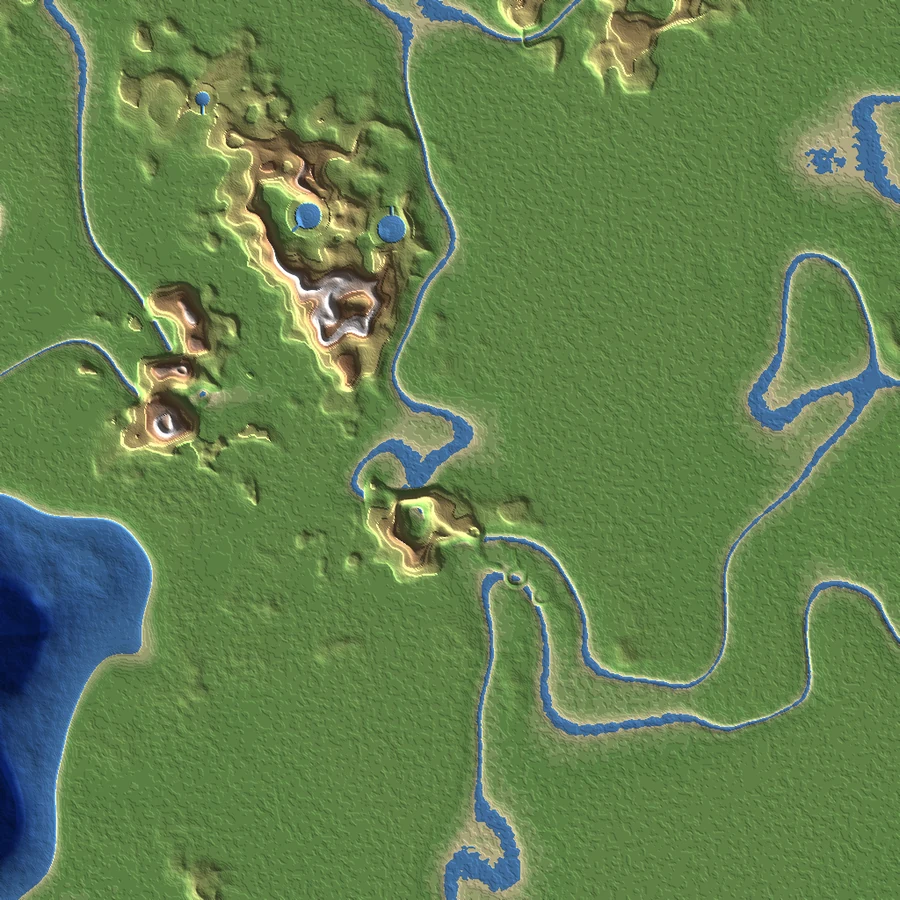
Last week's new land looked lively until you started walking on it. Nine tenths of the coast was a fringe of gravel, there was almost no sand by the water, and the coastline ran as a smooth curve without a single cape or bay. Mountains were smooth gray domes. And — we checked — not a single birch grove existed in the whole world: each tree's species was picked by a coin flip.
In a week the coast turned into a beach with grass running right down to the water, the mountains got ridges and plateau steps, and the forest started changing smoothly, in groves. These changes affect places generated for the first time: land already explored stays as it was.
Sky, shadows and one stuck key
The same day volumetric clouds with light and shade inside them appeared in the sky, along with a warm sunset band at the horizon and stars at night — on high graphics. And checking the shadows produced almost a joke: sun shadows had never worked. The shadow map was empty — not one of four million points had been written, and the picture looked the same with and without shadows. Now shadows fall, and they're cool and bluish, not just gray.
In the browser the W key got stuck — and the player ran twice as fast as normal. Entering the world stopped “lagging”: nine tenths of the entry time went into calculating light that needlessly went around the sky above the ground. Now light is calculated twelve times faster.
Release evening
On the evening of August 22 almost everything done that week went out to players. Right after that came the question: “Is there anything else to polish there?” A check found 38 loose ends, and some of them were closed that same night. The next day claims got a screen instead of commands: four taps instead of forty typed characters, with the borders shown by particles even before you confirm. That screen only reaches players in October, though — more on that in the next chapters.