“Just ship it already”
The week began with a list of 451 items — everything Anarchy had to have by its release. And it ended with a living Anarchy: on October 2, at 5:58 p.m. Moscow time, came the words “Just ship it already.”
A list of 451 items
By the end of September Anarchy had a long list: everything that should be in it. On September 28, 312 of the 451 items were marked done. Over the week we worked through more than two hundred small questions about exactly how one detail or another should work. Almost everywhere we chose the calmest option, but three times — the bold one. Structures in the world generator — make them before release, not after. TNT in structures and stashes — put it in, as planned. And a PvP ban pulls you out of an ongoing fight immediately rather than letting you finish it.
Twenty hours of structures
The decision about structures came on September 29 at half past nine in the morning. The last batch went into the world around five in the morning the next day. In those twenty hours Anarchy grew villages with a town hall, a smithy, a kitchen, fields and wells. There are no villagers in them, and that's a decision too: to the question “do villagers give anything of their own?” the honest answer was “no” — so they aren't needed. Animals and chests stayed.
Underground came mines, catacombs up to five levels deep and big caves of three kinds; by the water — shipwrecks, underwater ruins and a temple; in the desert — a tomb with a labyrinth and a crypt. Fortresses went up in rings around the world's center. The most atmospheric is the ancient city. Its shriekers hear footsteps within eight blocks if you don't sneak, and the fourth shriek wakes the guardian we made our own — today it's called the Bellringer. The trial hall was built of tuff: the trial stone summons a wave of monsters, and the vault opens with its own “Trial seal” — once per player.
In shipwreck chests you can now find a “Treasure hound”: click it and it tells you the distance to the nearest treasure, the direction and the depth, and a turquoise line of particles shows the way. Suspicious sand and gravel hide loot for the brush — four strokes, and the find is yours.
The day before release a subtle problem surfaced. The ancient city's guardian silently didn't show up a third of the time: the player heard the shriek, waited — and nothing. In narrow spots it happened three times out of four. Fixed on October 1.
Bosses at full strength and a border twice as wide
Bosses got their full sets of moves. In each phase a boss picks one move from its set, so fights became less predictable. Two new effects appeared: “Soar” throws a player into the air, and “Shackles” stop you from jumping — they're applied by the Blizzard Whirl's ice prison and Rockbreaker's stone cage. Fifteen moves stop or slow the boss itself: it stands still while casting — and that's your window to strike.
The world border moved out from ten to twenty thousand blocks from the center. The reason is simple: the nearest badlands mineshaft turned up 16,576 blocks away — beyond the old border. Wild monsters are still stronger far from spawn, but their strength now has a cap: otherwise in the corner of the world they'd be almost unkillable.
Tens of thousands of chests
“There'll most likely be tens of thousands of chests in the world,” came the word on the morning of October 2. We checked what would happen if there really were a hundred thousand of them, and got scared: saving a single chest would make the server freeze for almost a second every half minute. Worse, after a restart the server would load only the first four thousand chests, and the rest would quietly be rewritten as empty on the first change. All of this was redone before release: now the world holds up to two hundred thousand chests, and saving one takes about three thousandths of a second.
Things that wear out
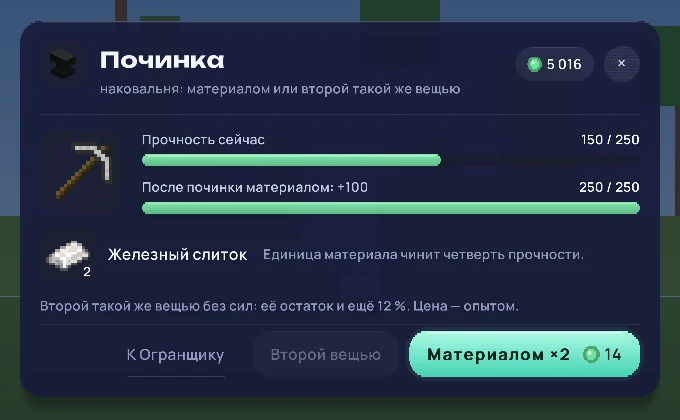
The same day items stopped being eternal. Tools, weapons and armor wear out and break, armor — from hits taken. The bow, crossbow, harpoon, war pike, fishing rod and even wings get used up — one point of durability per second of flight. You can repair on an anvil and with the Cutter: with material or a second identical item, paying with experience. The durability bar is visible right on the item's icon.
The main menu got a new face too. From several options we took the layout of one and the styling of another: a row of tabs at the top, under it a single glass card — “Hi!”, a server plate with its status, a big “PLAY” button, game recordings and a figure of your skin.
5:58 p.m.
On October 2 came the words: “Just ship it already.” At 5:58 p.m. Moscow time the server restarted with Anarchy. With it came a new browser client and four Anarchy maps: the spawn map, the dungeon, the cave and the arena hub. Your first entry into Anarchy leads to the spawn map, and Anarchy has its own wallet, starting from zero. Since September 4 the live server had run the same version — in that time more than 1,400 changes had piled up, and they all came out at once.
The evening through a player's eyes
In the evening we went into the live Anarchy as ordinary players and saw two things. The menus look bad — they're still simple forms with buttons. And the Anarchy shop offers survival ranks, even though Anarchy should have its own.
Overnight and on the morning of October 3, about sixty menus became real windows — with tabs, item slots, bars, ribbons, a calendar and search. A button you can't press right now grays out and says why next to it. Anarchy got its own eight ranks: Baron, Dragonborn, Deluxe, Paladin, Legend, Ragnarok, Emperor and Crazy. And in just seventy minutes all ten bosses got real models and five combat poses — the wind-up is stretched so that its top point falls exactly on the moment of impact, and you can tell from it when to dodge. At the same time models of the case altar, six crates and the figures on the spawn, dungeon and cave maps went into the game. All of this reached players with the next big update — on October 16.

The fourth of October
The chapter's last day set the tone for all of October. A request came in: make it possible to translate the whole game and all servers into many languages, leaving not a single untranslated spot — and to translate it ourselves, line by line. In one day we built a translation system, moved more than eleven thousand lines out of the code into dictionaries and translated them into English. To find what was forgotten, the game was run in a special test “language” where any untranslated phrase jumps out at once. In the morning there were 688 such spots, by evening 111. What happened next is told in the October notes.